Your family has outgrown the house. The children need their own rooms, the kitchen feels cramped every mealtime, and there is nowhere quiet to work from home. So you face the question so many families in Dorset and Hampshire wrestle with: do you extend the home you have, or do you sell up and move somewhere bigger?
We have worked with plenty of families on both sides of this decision. Some come to us after deciding to stay and improve. Others have already been through the moving mill and wish they had extended instead. There is no single right answer, but there are ways to think it through clearly. Here is how we help homeowners weigh it up.
What you actually gain from moving
Moving gives you a fresh start. A different layout, a different garden, perhaps a different school catchment or a shorter commute. If your current location genuinely does not work for your family, no amount of building will fix that. A new area is something only a move can deliver.
Moving can also be quicker in one sense: you get the finished space on the day you get the keys, without living through construction. For families who cannot face any disruption at all, that appeal is real.
But moving carries costs that rarely get talked about honestly. Estate agent fees, legal fees, survey fees, removals and stamp duty all add up before you have gained a single extra square foot of living space. Much of that money goes to third parties and leaves you with nothing tangible in the house itself.
Then there is the emotional weight. Uprooting children from friends and schools, leaving a neighbourhood you know, and starting over with a home that may still need work to suit you. In our experience, plenty of families who move end up renovating the new place anyway.
What you actually gain from extending
Extending keeps you where you are. Same street, same neighbours, same schools, same walk to the shops. For many families that stability is worth a great deal, especially when children are settled.
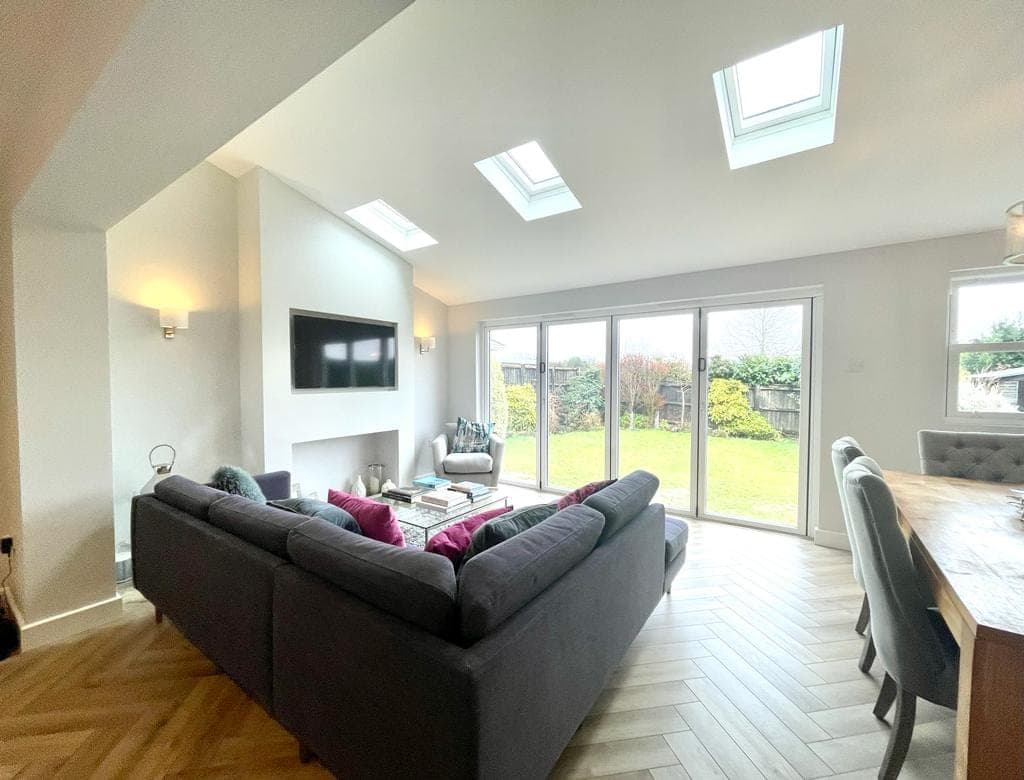
An extension also lets you create exactly the space you need rather than compromising on someone else's layout. A wider kitchen, a proper utility, a downstairs bedroom for an elderly relative, a home office that is genuinely quiet. You design around how your family actually lives.
Done well, an extension usually adds value to the property too. You are investing in an asset you own rather than paying fees to move. When you eventually do sell, a thoughtfully extended home tends to attract buyers looking for exactly the space you created.
Key takeaway: If you love your location, extending nearly always makes more sense than moving. If the area itself no longer works, moving is the only fix.
Start with your location, not the building
The first question we ask families is not about walls or budgets. It is about location. Do you like living where you live?
If the answer is a firm yes, that points strongly towards staying and improving. Location is the one thing you cannot change through building work. Everything else, the number of rooms, the flow of the ground floor, the amount of light, can be addressed on the plot you already own.
If the answer is no, if the commute is grinding you down or the school situation is wrong, then be honest with yourself. Spending on an extension will not solve a location problem, and you may resent the money later.
How much space do you really need?
Before deciding either way, get specific about what is missing. Vague frustration with a house is not a brief. "We need more space" could mean an extra bedroom, a bigger kitchen, a second bathroom, or simply better use of the rooms you already have.
Sometimes the space is already there, hidden. An underused garage, a large loft, or a poorly planned ground floor can often deliver what a family needs without extending the footprint at all. We have converted plenty of lofts and garages that gave families exactly the room they thought only a move could provide.
If you do need genuine extra footprint, a rear or side extension can transform how a house works. It is worth reading our guide on rear extension vs side extension to understand which suits your plot before you commit to any direction.
Understand what your plot allows
One factor that often decides the extend versus move question is what your plot and local rules actually permit. A generous garden gives you options. A tight plot, a conservation area, or a listed neighbour can limit how far you can build.
Many extensions across Dorset and Hampshire fall under permitted development, meaning you can build without a full planning application, within set limits. Others need planning permission, particularly on larger schemes or in protected areas. Getting a clear read on this early tells you whether your plans are realistic.
We always assess this at the outset. There is no point falling in love with a design that the plot cannot legally support. A short site visit usually reveals what is possible and where the constraints lie.
Weighing disruption honestly
The biggest fear families have about extending is living through the work. It is a fair concern. Building work brings noise, dust, tradespeople in and out, and a period where part of the home is out of action.
But moving is disruptive too. Packing an entire household, coordinating chains, and settling children into a new environment carries its own stress, just spread differently. The disruption of an extension is intense but temporary and finite. You know it will end and you know what you get at the end.
Good planning reduces the strain enormously. Phasing the work, protecting the parts of the house you still live in, and keeping the kitchen or a bathroom running for as long as possible all make a real difference. We plan projects around family life, not the other way round, and we are always upfront about the stages where things will feel toughest.
The middle path: extend and remodel
Often the best answer is not just more space but better space. A modest extension combined with reworking the existing layout can deliver far more than either alone.
Knocking through to create an open-plan kitchen and dining area, relocating a staircase, or opening up a dark hallway can make a house feel transformed without a huge new footprint. We frequently find that families who thought they needed to move simply needed their existing home to work harder.
If your project is heading in that direction, our extensions service covers everything from single-storey rear additions to more ambitious reconfigurations that change how the whole house feels.
Local factors in Dorset and Hampshire
Where you live shapes the decision too. In sought-after spots the cost of moving up to a larger property can be steep, which tilts the maths towards extending. In areas with strong demand, a well-built extension can be a sound long-term investment.
We work across the region, and families in and around Christchurch often find that extending lets them stay near the coast, the harbour and good schools without paying to move into a larger home nearby. Staying put and building up or out keeps you in a place people actively want to live.
Conservation areas, proximity to the New Forest, and older housing stock all bring their own considerations. Period homes in particular reward careful extension that respects the original character rather than fighting it.
Questions to ask yourself before deciding
When families are stuck, we suggest working through a few honest questions:
Do we love where we live?
If yes, lean towards extending. If no, moving may be the only real answer.
Is the space we need physically achievable here?
Check the plot, the loft, the garage and the layout before assuming you have to move.
Can we cope with a period of disruption?
If temporary upheaval is manageable, extending keeps your money in your own home.
What do we want in five to ten years?
Think beyond the immediate squeeze. A well-planned extension should serve the family as it grows and changes.
Our honest advice
We are builders, so you might expect us to always say extend. We do not. If your location no longer suits your life, we will tell you so, because there is no satisfaction in building an extension a family later regrets.
But for the many families who love where they live and simply need their home to do more, extending almost always wins. You keep your roots, you invest in your own property, and you get space designed around exactly how you live.
If you are weighing extension versus moving and want a straight, no-pressure opinion on what your home could become, we are happy to visit, look at the possibilities and talk it through. Get in touch through our contact page or call us on 07808 293854.