When we build extensions across Dorset and Hampshire, one of the most enjoyable conversations we have with homeowners is about the doors at the back. This is where the new room meets the garden, and it is often the single detail that shapes how the whole space feels. The two options that come up again and again are bi-fold doors and sliding doors. Both are excellent, both flood a room with light, and both look the part on a modern rear extension. But they behave very differently in daily life, and choosing well depends on how you actually use your home.
Here is our honest take, based on the extensions we have completed and lived-in feedback from clients months and years later.
How each type actually works
It helps to be clear on the mechanics before weighing up the pros and cons.
Bi-fold doors are made up of several panels hinged together. They concertina back on themselves and stack neatly to one side, or split to both sides, so you can open almost the entire span. When fully folded, the opening between garden and kitchen becomes wide and almost uninterrupted.
Sliding doors, by contrast, use large panels that glide on a track. One or more panels slide behind a fixed pane. They do not fold away completely, so a portion of the opening is always covered by glass, but the panels themselves are usually much larger, which means slimmer sightlines and bigger uninterrupted views when the doors are shut.
The quick summary
Bi-folds are about the opening. Sliders are about the view. That single sentence resolves a surprising number of decisions for our clients.
The view when the doors are closed
In the British climate, your doors spend far more of the year closed than open. That is worth sitting with for a moment.
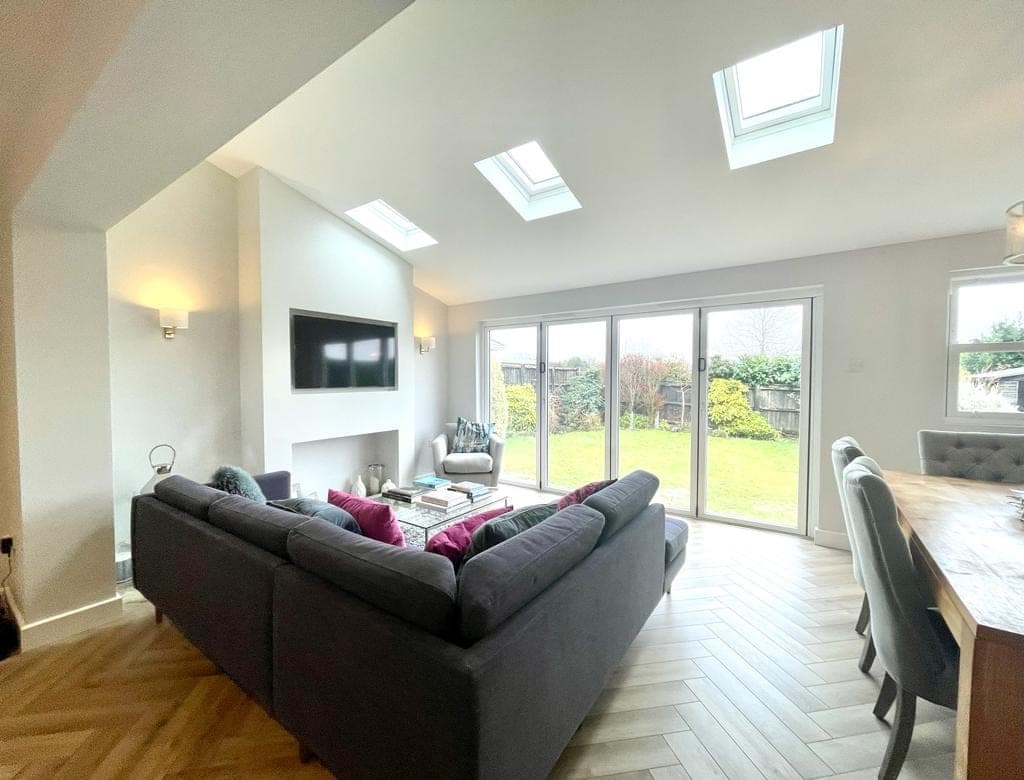
Sliding doors tend to win on the closed-door experience. Because each panel is large, there are fewer frames breaking up the glass. Standing in your kitchen on a grey January morning, you get a broad, clean picture of the garden with minimal interruption. For homeowners who value that framed view, especially with a nice garden or a green outlook near the New Forest, sliders are hard to beat.
Bi-folds have more vertical frames because each panel is narrower. When closed, you see those regular divisions across the glass. Some people love the rhythm of it and find it characterful. Others find it busier than they expected. There is no right answer, but it is worth standing in front of both in a showroom before you commit.
The opening when you want the garden in
This is where bi-folds shine. On a warm summer afternoon, folding the whole set back turns your kitchen or dining room into something close to an outdoor room. If you entertain, have children running in and out, or simply love the sense of removing the wall entirely, that dramatic full-width opening is genuinely lovely to live with.
Sliding doors can open a large portion of the span, but never the whole thing, because the sliding panel has to sit somewhere. For most people the opening you get is more than generous, but if your dream is a completely clear threshold, bi-folds deliver it and sliders do not.
Key takeaway: Choose bi-folds if you prioritise a fully open threshold in summer, and sliders if you prioritise the clean, uninterrupted view for the many months the doors stay shut.
Thresholds, level access and safety
One detail we always raise early is the threshold. A flush, level threshold between inside and out looks superb and makes the transition seamless, particularly if you want the same flooring to run through. It is also far friendlier for wheelchairs, prams and older relatives.
Both bi-folds and sliders can be specified with low or level thresholds, but the detailing underneath matters enormously. In our part of the coast, from Christchurch out towards Mudeford and Highcliffe, wind-driven rain is a real consideration. A level threshold needs proper drainage channels and careful falls in the paving outside, otherwise water finds its way in. We design this in from the start rather than treating it as an afterthought.
Sliding tracks sit slightly lower and are generally very robust. Bi-fold bottom tracks need keeping clear of grit and leaves so the wheels run smoothly, so if your extension opens onto a leafy garden, factor a little maintenance into your thinking.
Space inside and out
Bi-folds fold outwards or inwards. If they fold inwards, the stacked panels eat into your room. If they fold outwards, they need clearance on the patio and can be caught by wind if left open carelessly. Neither is a dealbreaker, but it changes how you plan furniture and paving.
Sliding panels stay within the plane of the wall, so they never intrude into the room or the patio. For smaller extensions where every bit of floor counts, that tidiness is a real advantage. We often steer clients with tighter footprints towards sliders for exactly this reason.
Glazing, warmth and running the home
Modern doors of both types can be specified with excellent double or triple glazing, thermal breaks and good weather seals. The frame material makes a difference too. Aluminium gives the slimmest sightlines and the strongest structure for large panels, which is why big sliders are almost always aluminium. Timber and composite options bring warmth and character and can suit a more traditional property beautifully.
Whatever you choose, the performance of the doors is only as good as the opening we build them into. A door is a large hole in your wall, and getting the lintel, cavity closers, damp-proofing and insulation right around it is what keeps the room comfortable and dry. This is the sort of detail that separates a proper build from a quick one, and it is worth reading our thoughts on getting an extension right in our guide to building an extension in Bournemouth.
Security and everyday use
Both systems can be highly secure with multi-point locking, and both meet the standards you would expect for a rear elevation. In day-to-day use, sliders tend to feel effortless because a single large panel glides open with one hand, ideal when you are carrying a tray out to the garden. Bi-folds involve unlatching and folding several panels, which takes a few seconds more but rewards you with that full opening.
Think about how you will use the doors on an ordinary evening, not just at a summer party. Many clients find they use one hinged access door on a bi-fold set for everyday coming and going, and only fold the whole thing back occasionally. If that sounds like you, it is worth confirming your bi-fold has a traffic door built in.
Matching the doors to your extension design
The right door also depends on the character of your home. A sleek contemporary extension on a property in Poole or Ferndown often suits large-format sliders with minimal frames. A more traditional or cottage-style home, common around the New Forest villages, can carry the divided rhythm of bi-folds or timber-framed sliders very naturally.
We always design the opening as part of the whole scheme rather than bolting a door onto a finished wall. Ceiling heights, roof lights, the position of the kitchen and the direction the room faces all feed into the decision. A south-facing extension may want solar-control glass to avoid overheating, while a north-facing one wants to grab every bit of light.
If your project sits in our home patch, we work throughout the area and know the local styles well. You can see more about how we help homeowners in Christchurch and the surrounding towns.
So which should you choose?
There is no universal winner, but our rules of thumb after many completed projects are these.
Choose bi-folds if the full-width open threshold matters most to you, you love bringing the garden right in during summer, and you do not mind a few more frames when the doors are shut.
Choose sliders if you want the cleanest possible view year-round, you have a smaller footprint where intruding panels would be a nuisance, or you prefer the one-handed ease of a big gliding panel.
And if you are torn, come and stand in front of both. We will happily talk through how each would work with your specific room, aspect and garden before anything is ordered. Getting this right is part of the wider craft of a well-built extension, which you can read more about on our extensions service page.
Let us help you decide
The doors at the back of your extension are something you will look at every single day, so it is worth taking the time to choose well. We are always glad to share what we have learned from real builds across Dorset and Hampshire and to help you weigh up bi-fold vs sliding doors for your own home.
To talk it through, get in touch via our contact page or call us on 07808 293854. We would love to help you design a rear extension that feels right in every season.